FPT University campus HCMC

Convocation Checkin Web

A semi-automated check-in system that projects real-time graduate information onto LED visuals during FPT University ceremonies.
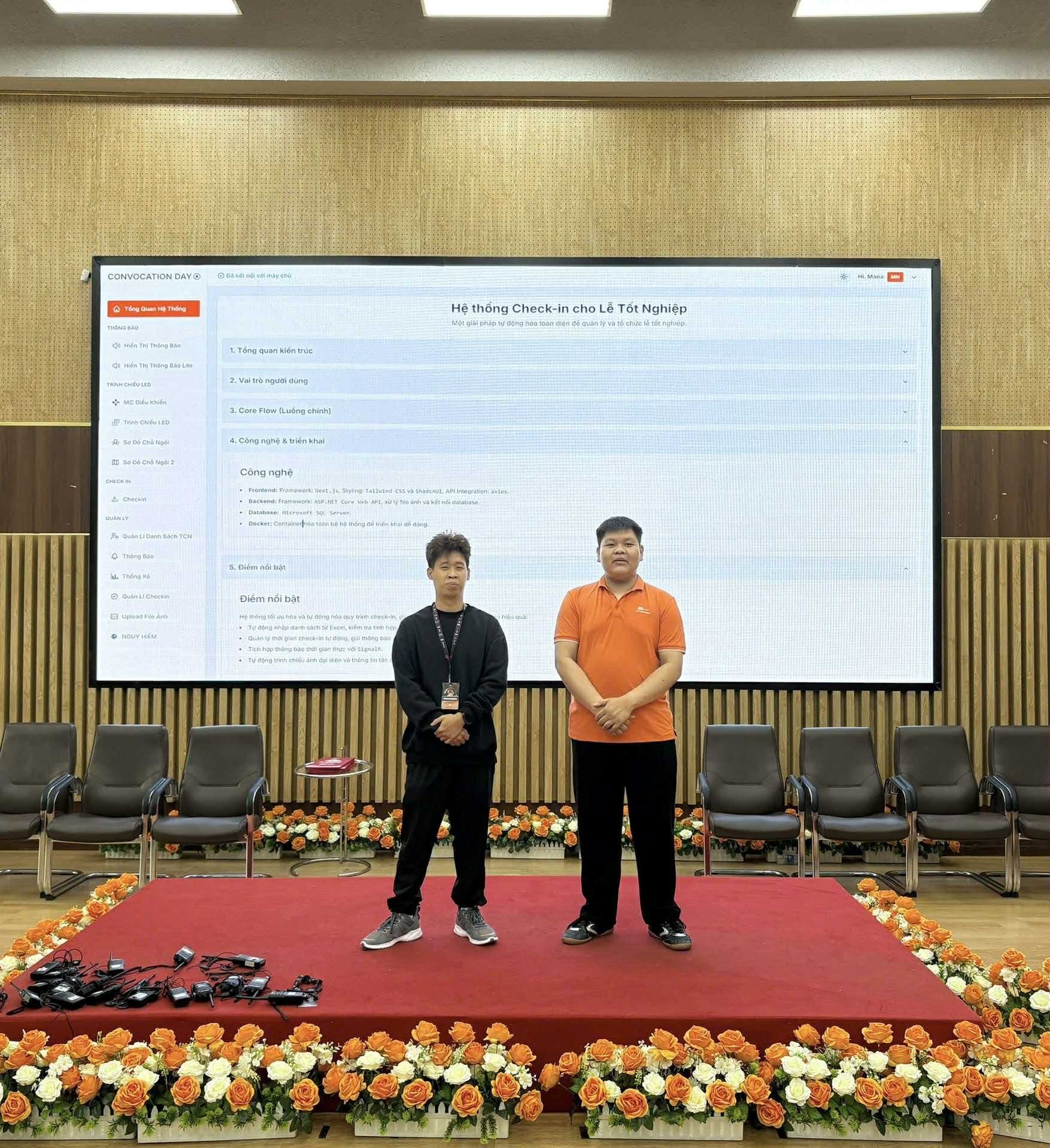
Convocation Checkin Web

onvocation Check-In Web is a semi-automated check-in system developed to support student reception and management during graduation ceremonies at FPT University – HCMC Campus.

The project was developed from March 2025 to May 2025 by a 3-member team consisting of 2 Backend Developers and 1 Full-stack & DevOps Developer. In this project, I worked as the Project Leader while also taking direct responsibility for frontend development, system integration, and DevOps.

The main goal of the project was to digitalize the graduation check-in process, reduce manual operations, and support real-time student information display on LED screens used during the ceremony.

The frontend was developed using Next.js and TypeScript, with a strong focus on responsive design and ease of use in a live-event environment. The system communicates with a .NET backend through REST APIs and uses JWT-based authentication for secure access.

One of the key features of the system is the real-time graduate information display module. When a student checks in or is selected from the control interface, the corresponding student information can be updated and displayed on the event LED screens.

I was responsible for designing the frontend structure, developing reusable components, integrating backend APIs, implementing authentication flows, and working closely with the backend team to resolve data and workflow-related issues.

In addition to application development, I also containerized the system using Docker and configured Jenkins CI/CD pipelines to automate the build and deployment process. This helped reduce manual deployment steps and improved system stability during important event operations.

As the Project Leader, I managed the project backlog, assigned tasks, monitored development progress, and communicated directly with the client to clarify requirements, check-in procedures, and real-world event workflows.

The main technologies used in the project included Next.js, TypeScript, .NET, SQL Server, JWT, Docker, and Jenkins.

This project gave me practical experience in developing software for live events, where system reliability, fast response times, and rapid troubleshooting are critical. It also allowed me to work across multiple responsibilities, including frontend development, system integration, DevOps, team coordination, and client communication.